Solar panels
Understanding the panels on your solar quote
Start with the panel count, wattage and full model code. Together, they tell you much more than a brand name or a claim that the panels are ‘high efficiency’.
Got a quote with unfamiliar panel names? Check your solar quote for free.
Reviewed 28 October 2026 · Sources and further reading below.
What does the wattage mean?
A panel labelled 450W has a rated power of 450 watts under standard laboratory test conditions. It will not produce that amount throughout the day. Sunshine, temperature, shade and the way the panels face all affect what you get.
A datasheet is the manufacturer’s specification sheet. Look for the row called rated power or maximum power, measured in W or Wp. Wp means watts peak. Check the column for the exact panel on your quote: one sheet can cover several versions.
You may see other power figures for different test conditions or light reaching the back of a panel. Do not substitute the biggest figure for the rating on your quotation. Ask which figure the installer used and why.
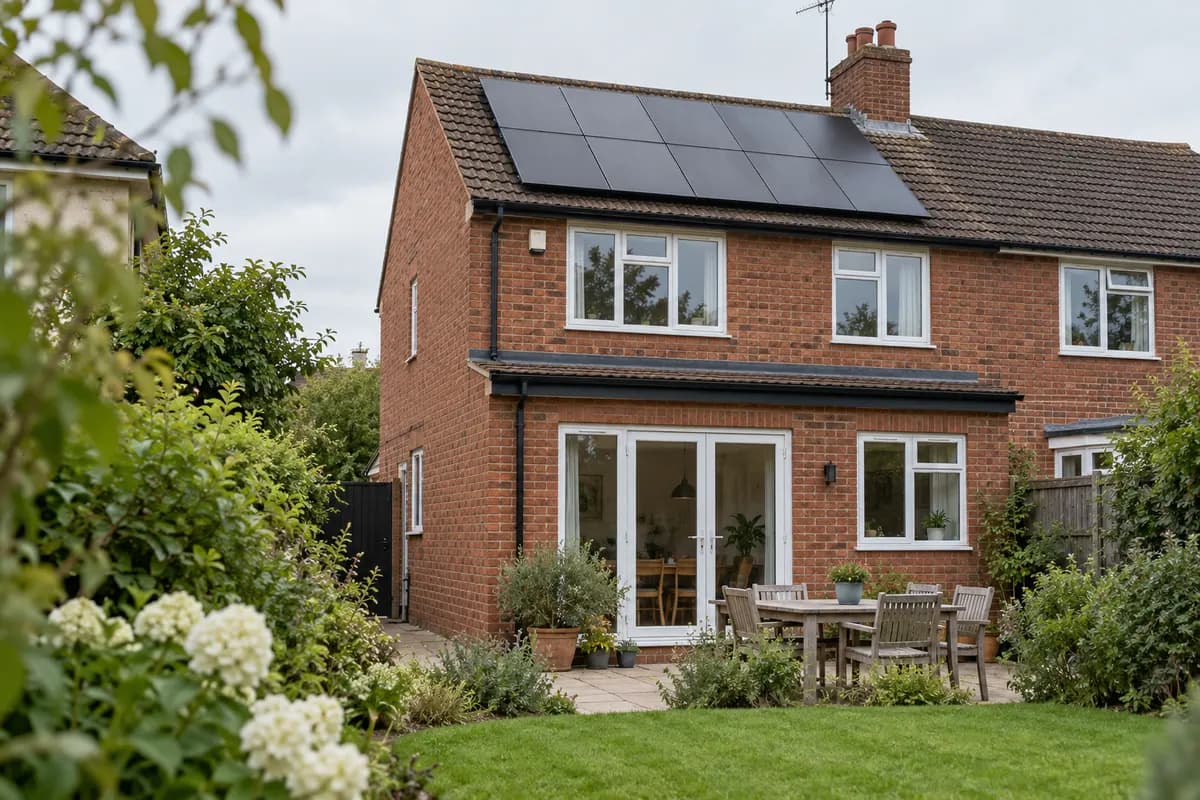
Illustration only — not a specific product or installation design.
Panel count × wattage = rated system size
- 12 panels
- Number quoted
- × 450W
- Rated power per panel
- = 5.4kWp
- Combined rated power
Example figures. Rated panel power does not tell you how much electricity your roof will produce in a year.
How do panel count and kWp fit together?
kWp means kilowatts peak: the combined rated power of the panels. There are 1,000 watts in one kilowatt. For identical panels, multiply the panel count by the wattage, then divide by 1,000.
Same rated power, different panel counts
These example quotes use invented figures.
Quote A: 12 panels × 450W = 5,400W, or 5.4kWp.
Quote B: 10 panels × 540W = 5,400W, or 5.4kWp.
Both have the same total rated panel power. That does not tell you whether they take up the same roof space, produce the same electricity over a year or offer the same value.
kWh is different. Kilowatt-hours measure an amount of electricity, such as your home’s yearly use or the installer’s yearly generation estimate. A 5.4kWp system is not a promise of 5,400kWh a year. Ask for a separate estimate based on your roof and location.
Is a more efficient panel always better?
Efficiency describes how much of the sunlight falling on the panel becomes electricity under the stated test conditions. Higher efficiency can mean more rated power from the same area. That can help when roof space is tight.
Higher wattage alone does not prove higher efficiency: the panel might simply be larger. Compare efficiency and dimensions together, then ask how many panels actually fit. A higher efficiency percentage is not a forecast of an equal percentage increase in your bill savings.
Why do the full model code and dimensions matter?
A brand or range name can cover several panels. Copy the complete code from the quote, including its ending. Match it to the manufacturer’s sheet rather than assuming that a similarly named product is the same.
Check the panel’s length and width, usually shown in millimetres. Ask for a roof layout using that exact model. The installer also needs to allow for the roof’s shape, obstacles and the requirements of the mounting system. Adding up panel areas alone cannot confirm that an installation will fit.
If the installer proposes a substitute, ask for the new model code, datasheet and revised layout before agreeing. Compare the wattage, size, warranties and full price again.
How to find the right datasheet
- Ask the installer for it. Request the manufacturer’s document for the exact model and wattage being supplied in the UK.
- Check the manufacturer’s website. Use its product or downloads section. A retailer’s summary may leave out conditions or show an older version.
- Match the details. Check the full code, wattage column, dimensions, market and document revision. Keep the file with your quotation.
- Resolve differences in writing. If the quote and sheet disagree, ask the installer to confirm what you will receive. Do not choose whichever number looks better.
You do not need to interpret every electrical value. Leave the detailed design checks to the installer. Your aim is to understand and identify what you are buying.
What about a 25- or 30-year warranty?
Check which promise the number refers to. A product warranty concerns covered defects. A performance warranty sets conditions for the panel’s remaining power output as it ages. It is not a guarantee of your annual electricity production or savings.
Ask for the full applicable terms, including any installation or registration conditions. Read our guide to solar equipment warranties for the repair costs and claims questions that a headline number does not answer.
Five questions to send your installer
- What is the exact panel model and wattage, and can you send its UK-applicable datasheet?
- How many panels are included, and do they add up to the system size stated on the quote?
- Can you show where these panels fit on my roof, allowing for obstacles and mounting requirements?
- What yearly electricity production do you estimate for my roof, and what assumptions could change it?
- Which product and performance warranties apply, and what happens if you need to substitute a panel?
Put the answers beside your other quotation using our like-for-like comparison worksheet. If the panel and inverter sizes differ, our inverter guide explains which power figures to ask about.
Sources and further reading
Checked 28 October 2026. Manufacturer documents apply only to their stated models and versions.
- JA Solar JAM54D41 MB datasheet (PDF), Global-EN-20241105A, page 2: model columns, test conditions, efficiency and dimensions. Used to explain how a datasheet works, not to verify the product in your quote.
- Energy Saving Trust: solar panels: system size, roof direction and shading.
- REC Alpha warranty (PDF), revision 9, October 2026, pages 3–4: separate product and performance promises; European terms explicitly include the UK.
- MCS guidance for contracts and quotations (PDF), February 2026, pages 4–6: equipment details, estimates and written terms.
Before you sign, check your quote
Use Fairbeam to review the price and equipment, then take any questions back to the installer providing your quote. Free, with no sign-up or login.
Check your solar quote for freeThis is automated general guidance. It does not replace a property survey or confirm installation suitability, warranty eligibility or savings.
Our optional competing-quote beta records area-level interest from homeowners who have not signed. It does not guarantee an installer is available, arrange an introduction or send your contact details to installers.